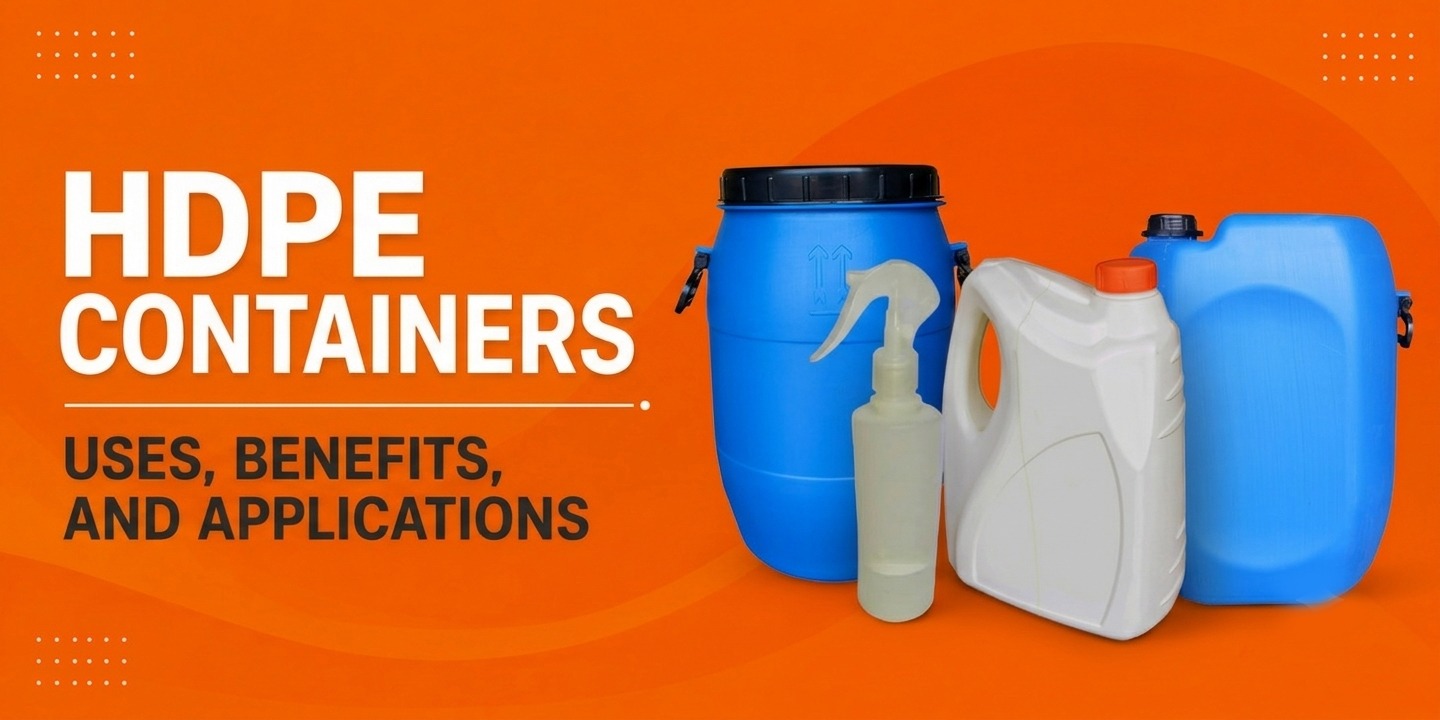
HDPE containers are widely used for storing, protecting, and transporting liquids, chemicals, food products, lubricants, cleaning solutions, agricultural products, and other industrial materials. Made from High-Density Polyethylene (HDPE), these containers are valued for their durability, lightweight construction, chemical resistance, and versatility.
For businesses looking for reliable plastic packaging, understanding the properties, applications, and manufacturing options of HDPE containers can help in selecting the right packaging solution.
What Are HDPE Containers?
HDPE containers are plastic containers manufactured using High-Density Polyethylene, a strong and versatile thermoplastic material. HDPE is commonly used to manufacture bottles, jars, drums, jerry cans, buckets, and other industrial packaging products.
The material allows manufacturers to produce containers in different shapes, capacities, closures, and designs according to specific product and industry requirements.
At ASL Plastic Private Limited, the product range includes plastic HDPE jars, HDPE drums, plastic containers, jerry cans, buckets, HDPE lotion bottles, spray bottles, toilet cleaner bottles, and other packaging solutions. The company states that it has a product range of more than 500 categories and sub-categories.
Why Is HDPE Used for Plastic Containers?
HDPE is popular in packaging because it offers a useful combination of strength, durability, chemical resistance, and flexibility in manufacturing.
HDPE containers can be designed for different capacities and applications, from smaller bottles and jars to larger drums and industrial containers. ASL Plastic’s listed product range includes sizes such as 1 litre, 2 litre, 4 litre, 10 litre, 30 litre, 40 litre and 50 litre, along with different types of jars, drums, buckets, and jerry cans.
Key Benefits of HDPE Containers
- Strong and Durable: HDPE containers are designed to withstand regular handling, storage, and transportation. Their durability makes them suitable for both everyday packaging and demanding industrial applications. For businesses transporting products over longer distances, durable packaging can help reduce the risk of container damage during handling.
- Good Chemical Resistance: One of the important advantages of HDPE is its suitability for many chemical and industrial packaging applications. This makes HDPE containers useful for products such as chemicals, lubricants, agricultural products, and cleaning solutions. ASL Plastic manufactures plastic jars, containers, PET bottles and lids for applications involving edible oil, lubricants, chemicals, and pesticides.
- Lightweight and Easy to Handle: Compared with many traditional packaging materials, plastic containers can provide a practical combination of strength and relatively low weight. This makes them easier to handle, stack, transport, and use.
- Available in Different Shapes and Sizes: HDPE containers can be manufactured in different designs to match product requirements. Depending on the application, businesses can select bottles, jars, drums, buckets, jerry cans, or specially designed containers. ASL Plastic lists products including 5-litre HDPE jars, 10-litre HDPE jars, 10- and 15-litre jerry cans, HDPE bottles, plastic drums, and industrial buckets.
- Suitable for Custom Manufacturing: For businesses with specific packaging requirements, plastic moulding allows containers and components to be developed according to customer specifications. ASL Plastic uses injection moulding, extrusion blow moulding, and PET blow moulding for OEM applications across industries including automotive, food processing, agriculture, chemical industries, and their ancillary sectors.
Common Uses of HDPE Containers
- Chemical Industry: HDPE containers are commonly used for packaging and handling various chemical products because of their durability and suitability for many chemical applications. Industrial HDPE jars, drums, bottles, and jerry cans can be selected according to the product’s characteristics, required capacity, and handling conditions.
- Agriculture: Agricultural businesses use plastic containers for products such as pesticides, agricultural chemicals, and related materials. ASL Plastic specifically identifies agriculture among the industries served through its plastic moulding capabilities.
- Lubricant Packaging: HDPE containers are also used for lubricants and automotive-related fluids. ASL Plastic lists lube buckets, lube drums, and lubricant packaging containers among its products.
- Cleaning Products: HDPE bottles are suitable for many household and commercial cleaning products. ASL Plastic’s range includes toilet cleaner bottles, floor cleaning bottles, trigger spray bottles, and cleaning spray bottles.
- Food and Food Processing: Plastic packaging is also used in food-related applications when the container design and material are appropriate for the specific product and applicable requirements. ASL Plastic identifies food processing as one of the industries supported through its moulding capabilities and also lists food packaging products.
- Personal Care and Hygiene Products: HDPE bottles and containers are used for products such as lotions, sanitizers, and other hygiene-related products. ASL Plastic lists HDPE lotion bottles, hand sanitizer bottles, and hygiene/disinfectant/sanitizer bottles in its product range.
HDPE Containers vs Other Plastic Packaging
The right plastic container depends on the product, capacity, storage conditions, filling process, closure requirements, transportation needs, and industry standards.
For example, HDPE may be a strong choice where durability and chemical resistance are important, while PET can be preferred for applications where transparency and appearance are key requirements.
Therefore, businesses should select packaging based on the product requirements rather than simply choosing the most common plastic material.
How Are HDPE Containers Manufactured?
HDPE containers can be produced using different plastic moulding processes depending on their design and application.
Blow moulding is commonly used for hollow products such as bottles, jars, and containers. Injection moulding can be used for various plastic components and products, while other moulding technologies can be selected based on the product design.
ASL Plastic states that its manufacturing capabilities include 50-ton to 500-ton injection moulding and 5-litre to 100-litre blow moulding.
The manufacturing process can involve product design, mould development, material preparation, moulding, quality inspection, and finishing or assembly depending on the product.
What Should You Consider When Choosing an HDPE Container?
Before purchasing HDPE containers, businesses should consider the type of material being stored, required capacity, container dimensions, closure type, wall thickness, transportation conditions, filling process, storage environment, and required specifications.
For OEM and custom requirements, it is also important to work with a manufacturer capable of supporting product development and mould design.
ASL Plastic states that it provides CAD-based design and development, including mould-flow and structural analysis, and can support customers from concept through production.
Why Choose ASL Plastic for HDPE Containers?
ASL Plastic Private Limited has been operating since 1948 and states that it has more than 75 years of experience in plastic manufacturing. The company offers a broad range of plastic packaging and moulded products, including HDPE jars, drums, jerry cans, buckets, bottles, containers, and related components.
Its manufacturing capabilities include injection moulding and blow moulding, while its products serve industries such as automotive, food processing, agriculture, chemical, and related ancillary industries.
ASL Plastic also states that its products are manufactured according to client specifications, with raw-material quality control and dimensional checks according to specified tolerances.
Frequently Asked Questions
Are HDPE containers durable?
Yes. HDPE is widely used for containers where strength, durability, and resistance to regular handling are important.
What products can be packed in HDPE containers?
Depending on the container design and material compatibility, HDPE packaging can be used for products including chemicals, lubricants, agricultural products, cleaning products, hygiene products, and various industrial materials.
What types of HDPE containers are available?
Common options include HDPE bottles, jars, drums, buckets, jerry cans, and industrial containers. ASL Plastic offers several of these product categories.
Can HDPE containers be customized?
Yes. Plastic moulding enables manufacturers to develop different shapes, capacities, designs, closures, and components according to customer requirements.
Where can businesses buy HDPE containers in India?
Businesses can source HDPE containers directly from experienced plastic container manufacturers such as ASL Plastic Private Limited, particularly when they require bulk quantities, customized packaging, or OEM manufacturing support.
Conclusion
HDPE containers offer a practical packaging solution for businesses that need durability, versatility, chemical resistance, different capacity options, and reliable handling. They are used across chemical, agriculture, lubricant, cleaning, food processing, hygiene, and industrial applications.
With more than 75 years of experience, a range of over 500 product categories and sub-categories, and injection and blow moulding capabilities, ASL Plastic Private Limited provides HDPE jars, bottles, drums, jerry cans, buckets, and other plastic packaging solutions for different industrial requirements.
For businesses looking for HDPE containers, jars, bottles, drums, or customized plastic packaging, ASL Plastic can be considered for both standard and OEM requirements.