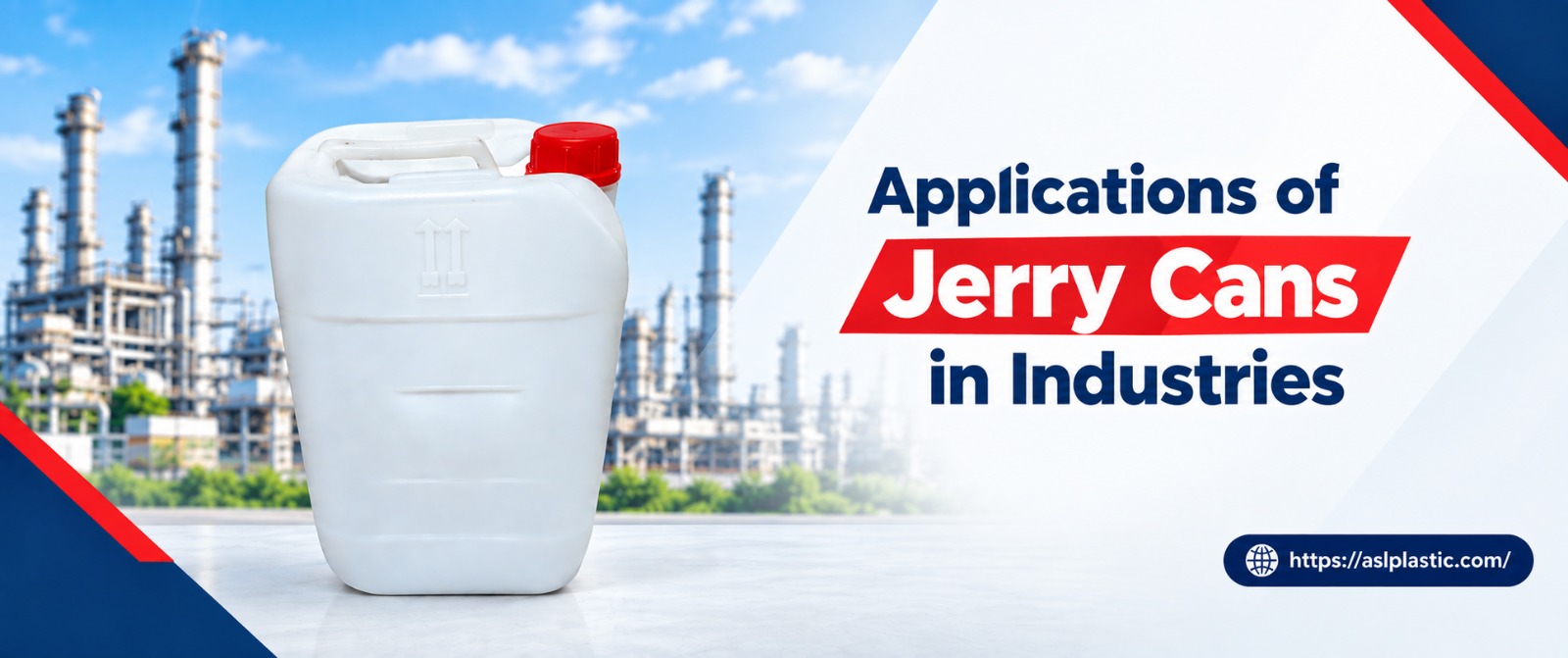
A jerry can may look like a simple plastic container, but in many industries it plays an important role in storing, handling and transporting liquids and semi-liquid products. The right container needs to be practical, durable, easy to handle and suitable for the product being packed.
Plastic jerry cans are made from HDPE and are widely used in various industries like manufacturing, chemical, FMCG, dairy, and retail. Their shape makes them relatively easy to carry, store, and move, while available capacities let businesses choose packaging to suit their application.
At ASL Plastic, jerry cans are part of a wider range of plastic packaging products. The company currently lists 10 ,12 & 20 ltr jerry cans, along with other industrial containers, HDPE jars, drums, bottles and buckets. ASL Plastic has been manufacturing plastic products since 1948 and has blow moulding capability for containers from 5 litres to 100 litres.
So, where are jerry cans actually used?
20 common industrial applications of Jerry Cans
1. Lubricant and Lubricating Oil Packaging
Lubricant manufacturers need containers that can be handled easily during filling, transportation and storage.
Jerry cans can be used for suitable lubricant products where the container design, material and closure are compatible with the formulation. ASL Plastic also manufactures packaging products for lubricants and lists lube buckets and other industrial packaging in its product range.
For distributors, workshops and industrial users, a properly designed handle can also make pouring and handling more convenient.
2. Agricultural Chemical Packaging
Agriculture involves the use of several liquid products, including pesticides, crop-protection products and other agricultural formulations.
Jerry cans can provide a practical packaging format for products that require larger quantities than conventional bottles.
However, the container should always be selected according to the chemical formulation, concentration, closure requirements and applicable packaging regulations.
ASL Plastic identifies agriculture and chemical industries among the sectors supported by its plastic moulding capabilities.
3. Chemical Industry
Chemical manufacturers often require packaging that can withstand regular handling and transportation.
HDPE is used for many industrial containers because of its useful combination of durability and chemical resistance. However, not every HDPE container is suitable for every chemical.
Before selecting a jerry can, manufacturers should consider:
- Chemical compatibility
- Container wall thickness
- Closure type
- Filling temperature
- Storage conditions
- Transportation requirements
This makes product-specific container selection particularly important.
4. Cleaning Chemical Packaging
Floor cleaners, industrial cleaning liquids, detergents and other cleaning formulations are commonly sold in plastic packaging.
Jerry cans become useful when the product is supplied in larger quantities for:
- Commercial cleaning companies
- Hotels
- Hospitals
- Factories
- Offices
- Institutional users
A larger container can reduce the frequency of replacement compared with smaller consumer packs.
5. Automobile and Automotive Fluid Packaging
Automotive businesses handle several types of fluids, including lubricants, coolants and other maintenance products.
Jerry cans can be used for suitable automotive fluids when the material and design meet the product’s packaging requirements.
ASL Plastic has experience manufacturing plastic components and containers for the automotive sector, including brake and clutch fluid containers, coolant tanks and other automotive components.
6. Industrial Oil Packaging
Industrial machinery depends on different types of oils and fluids for operation and maintenance.
Manufacturers and distributors may use jerry cans for packaging selected industrial oils in quantities suitable for workshops, maintenance teams and industrial customers.
The rectangular form also makes the container convenient for storage compared with some round containers.
7. Food-Related Liquid Packaging
Some food-processing businesses use plastic containers for suitable liquid or semi-liquid products.
For food applications, the packaging material and manufacturing process must meet the relevant food-contact requirements. A container should not be treated as food-safe simply because it is made from plastic.
ASL Plastic serves the food-processing industry and manufactures various plastic packaging products.
8. Edible Oil Packaging
Edible oil manufacturers and distributors require packaging that is easy to fill, close, transport and dispense.
Depending on the product and applicable food-contact requirements, appropriately designed plastic containers can be used for different edible oil packaging applications.
ASL Plastic specifically mentions plastic jars, containers, PET bottles and lids for edible oil among its product applications.
9. Water and Utility Applications
Jerry cans are also associated with the movement and storage of water in different work environments.
For example, they may be useful in:
- Construction sites
- Workshops
- Agricultural operations
- Outdoor work locations
- Utility areas
The exact application depends on whether the container is designed and approved for the intended use.
10. Paint and Coating Industry
Paints, coatings and related formulations require packaging that can be selected according to the product’s chemical characteristics.
For larger quantities, plastic jerry cans can offer a convenient format for transportation and handling.
Before using a container for paint or coating products, manufacturers should verify compatibility with the formulation and ensure that the closure prevents leakage during transportation.
11. Construction Chemical Packaging
Construction sites use a variety of liquid construction chemicals, including selected waterproofing products, admixtures, bonding agents and other formulations.
Jerry cans can be useful for packaging products supplied in medium-sized quantities.
For construction chemical manufacturers, the container is not simply a packaging choice. It also needs to suit:
- Product viscosity
- Chemical composition
- Filling process
- Storage duration
- Transport conditions
12. Fertilizer and Agricultural Liquid Products
Modern agriculture uses various liquid fertilizers and nutrient formulations.
Suitable plastic jerry cans can make these products easier to distribute and handle, particularly where larger quantities are required.
The packaging should be compatible with the formulation and designed according to the manufacturer’s handling and storage requirements.
ASL Plastic’s manufacturing capabilities include applications for the agriculture industry, making this an important area for industrial plastic packaging.
13. Household Chemical Products
Some household chemical products are sold in larger packs for institutional or commercial users.
Examples can include:
- Cleaning solutions
- Detergent formulations
- Disinfectant products
- Maintenance chemicals
A jerry can can be useful when the customer needs more product than a standard household bottle can provide.
14. Institutional Cleaning Supplies
Hotels, hospitals, restaurants, schools and large offices often purchase cleaning products in bulk.
Instead of supplying many small bottles, manufacturers may use larger containers for selected formulations.
The advantage is practical: fewer individual containers can mean easier inventory management and less frequent replenishment.
Again, the container must be appropriate for the specific formulation and intended use.
15. Industrial Disinfectant Packaging
Disinfectants are used across healthcare, hospitality, manufacturing and commercial environments.
Where the formulation and regulatory requirements permit, jerry cans can provide a practical bulk packaging solution.
For these products, the closure and container compatibility are particularly important because leakage during transportation or storage can create unnecessary handling problems.
ASL Plastic manufactures a range of hygiene, disinfectant and sanitizer bottles as part of its broader plastic product portfolio.
16. Chemical Distribution and Supply Chains
A jerry can is not only a packaging container. It is also part of the supply chain.
A manufacturer may fill the product at its facility, send it to a distributor, store it in a warehouse and finally deliver it to an industrial customer.
That means the container needs to perform through several stages:
Filling → Sealing → Storage → Transportation → Distribution → End Use
A practical shape and suitable handle can make repeated handling easier.
17. Workshop and Maintenance Products
Workshops regularly use oils, cleaners, maintenance fluids and other industrial products.
Jerry cans can be useful where products are supplied in larger quantities and need to be transferred into smaller working containers or dispensing equipment.
Their use can help businesses organise bulk supplies while keeping the primary product container closed until required.
18. Industrial Solvents and Specialty Formulations
Certain solvents and specialty industrial formulations require carefully selected packaging.
Plastic jerry cans may be considered for compatible products, but this is an area where businesses should never select packaging based only on container size or appearance.
Chemical compatibility testing and supplier recommendations should be considered before production.
The packaging material, closure and container construction all need to match the formulation and transport requirements.
19. Export and Bulk Product Packaging
Manufacturers supplying products to distributors outside their immediate market often need packaging that can handle transportation and storage.
Jerry cans can be considered for suitable products where their capacity, dimensions and closure system meet the requirements of the supply chain.
For export applications, businesses should also consider:
- Packaging regulations
- Labelling requirements
- Transport regulations
- Pallet configuration
- Leakage prevention
- Product compatibility
The container is one part of the complete export-packaging system.
20. OEM and Customized Industrial Packaging
Not every business needs an off-the-shelf container.
Some manufacturers need a specific capacity, shape, neck design, closure, colour or other dimensional requirement to match their product and filling line.
This is where plastic moulding expertise becomes important.
ASL Plastic works with injection moulding, extrusion blow moulding and PET blow moulding and states that its manufacturing capabilities support OEM applications across industries such as automotive, food processing, agriculture and chemicals.
What Makes a Jerry Can Practical for Industrial Use?
There is no single feature that makes a jerry can suitable for every application. Its usefulness comes from a combination of design and material characteristics.
- Easy Handling: The integrated handle found on many jerry can designs makes lifting, carrying and pouring more convenient.
- Multiple Capacity Options: Different industries require different quantities. ASL Plastic currently lists 10 ,12 & 20 Litre jerry cans, while its wider product portfolio includes several other container capacities.
- Suitable Plastic Materials: HDPE is widely used for industrial containers because it offers durability and useful chemical-resistance characteristics.
- Still, the exact material grade must be selected according to the application.
- Practical Storage: The shape of many jerry cans allows businesses to use warehouse and transport space efficiently compared with irregularly shaped containers.
- Manufacturing Flexibility: Modern blow moulding allows manufacturers to produce containers in different sizes and designs.
ASL Plastic states that its blow moulding capability covers containers from 5 litres to 100 litres, giving manufacturers options beyond small-volume packaging.
How to Select the Right Industrial Jerry Can
Choosing a jerry can should start with the product, not the container.
Before placing an order, businesses should check:
- What product will be packed?
Chemical, lubricant, agricultural product, cleaner, food product or another formulation? - What capacity is required?
The quantity should match customer demand and handling requirements. - Is the material compatible?
Chemical compatibility is essential for industrial packaging. - What closure is required?
The cap and neck design should provide the required sealing performance. - How will it be transported?
Road, warehouse, export or other logistics conditions can affect container selection. - Does the filling line support the container?
Dimensions and opening design should work with the filling process. - Are there industry-specific regulations?
Food, chemicals, hazardous materials and other sectors may have additional requirements.
Why Work With an Experienced Plastic Manufacturer?
Industrial packaging is different from buying an ordinary plastic container.
A manufacturer needs to understand material selection, mould design, production consistency, dimensions and application requirements.
ASL Plastic has been operating since 1948 and states that it has more than 75 years of experience, a product range covering more than 500 categories and sub-categories, and manufacturing capabilities covering injection moulding, extrusion blow moulding and PET blow moulding.
The company also states that its products are manufactured according to client specifications under its quality plan, with raw-material quality control and dimensional tolerances.
For businesses looking for industrial plastic packaging, these capabilities can be important when a standard container is not enough and application-specific requirements need to be considered.
Final Thoughts
Jerry cans have moved well beyond their traditional image as simple liquid containers. Today, they can be found across sectors such as agriculture, chemicals, automotive, lubricants, cleaning products, construction and industrial supply chains.
But the most important point is this: the right jerry can depends on the product it is going to hold.
Capacity, material, chemical compatibility, closure, transportation conditions and regulatory requirements should all be considered before selecting a container.
With its long manufacturing history, range of plastic packaging products and moulding capabilities, ASL Plastic provides jerry cans and other plastic container solutions for businesses looking for application-focused packaging options.
For industrial buyers, the goal should not simply be to find a plastic jerry can. It should be to find a container that works reliably with the product, filling process, transportation system and end-user requirements.